- Monday Morning Memo
- Posts
- Capitol On Edge


NYS Senate photo
Good morning from Albany, New York, where hope for a budget deal springs eternal! Could that elusive agreement be in the offing before Memorial Day? It all depends on who you ask. Assembly Speaker Carl Heastie expressed his optimistic view of passing budget bills later this week, while Senate Deputy Majority Leader Mike Gianaris offered a contrarian view of this, his last budget before leaving office later this year, saying the chances of wrapping up the budget this week are “very slim.”
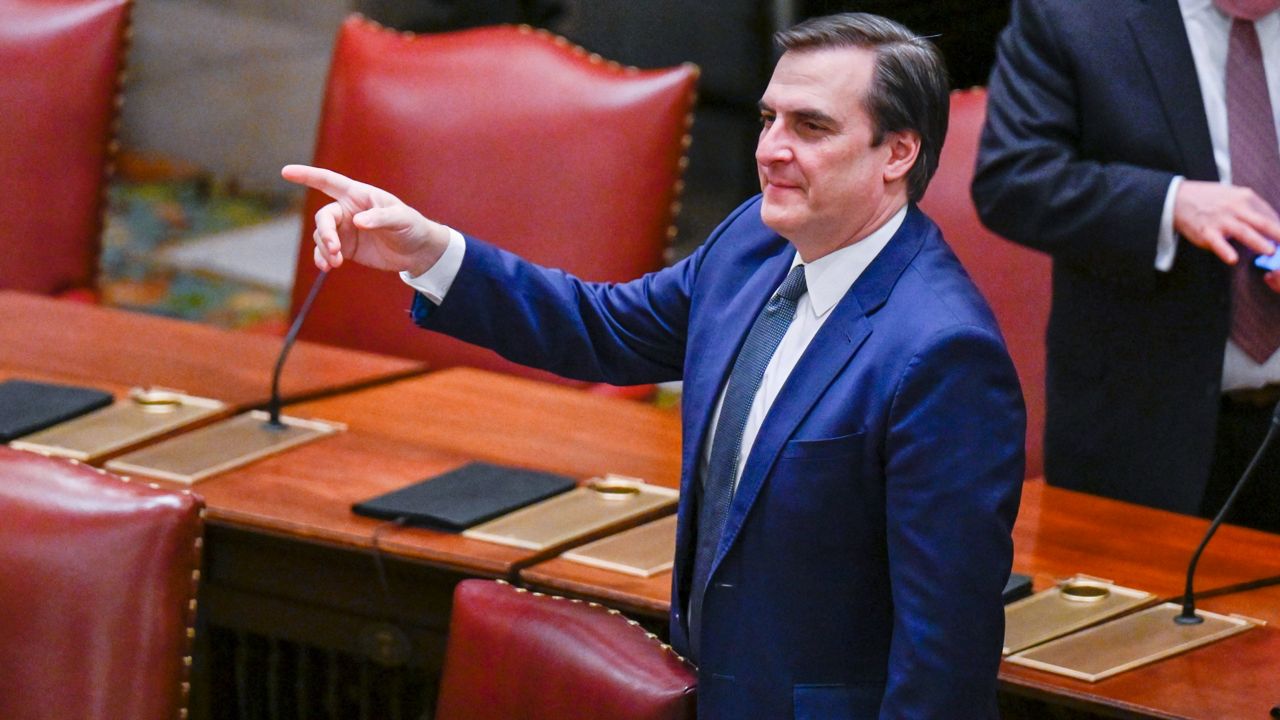
Senate Majority Leader Andrea Stewart-Cousins continued with her usual formula—noting progress has been made—declared this budget to be “entering the beginning of the end.” In the meantime, lawmakers passed a 12th budget extender and are set to pass another one today to fund state operations as negotiations continue to lurch towards an end.
Details of various agreed-upon budget items continue to emerge, including additional cash assistance for New York City to help Mayor Zohran Mamdani close the $5.4 billion budget gap without raising property taxes or cutting services. Hochul announced an additional $4 billion in state aid, comprising expected revenue from the pied-à-terre tax on second homes, $2.3 billion in pension restructuring, funding for universal childcare, and over $500 million in relief from class-size mandates in public schools. In a statement, Hochul said, “Today, we are fulfilling the promise to make free universal childcare a reality, making significant investments in education, public safety, and infrastructure while providing the city the resources they need to continue to fund critical services for New Yorkers.” Mamdani’s first budget as mayor will keep spending largely flat for fiscal year 2027, but the influx of state aid and new revenue streams allowed Mamdani to forgo dipping into New York City’s reserves to fund the $124.7 billion budget.
Do you support the state’s decision to provide $4 billion in gap-closing funding for New York City’s budget? Have your say in our poll below!
While Mamdani was ultimately unsuccessful in lobbying Albany to allow him to raise taxes on the wealthy directly, he has pointed to the pied-à-terre tax and a repeal of a city unincorporated tax credit as ways he is making good on his campaign promise. At his budget presentation, Mamdani offered, “For too long, working New Yorkers have been told that austerity was the answer to adversity. This budget rejects that failed politics. We are restoring fiscal stability without slashing the services people depend on, without raising property taxes, and without asking working families to pay for a crisis they did not create. Instead, we are making government work for the people of this city: securing support from Albany and taxing the rich so we can invest in housing, safety, childcare, parks, libraries, and the public goods that make New York the greatest city in the world.”
We are also hearing details about that pied-à-terre tax and some general ideas around potential Tier 6 changes, including all Tier 6 employees being able to retire at 58 (down from 63), lower pension contribution rates, and about $30,000 of yearly overtime earnings would be counted in workers’ final average (up from $21,500). To be clear, neither of those issues appears fully agreed upon, but they seem close. Another big unresolved piece is the 450,000 New Yorkers losing health coverage in July as a result of HR1 (generally, enrollees who make between 200% and 250% of the federal poverty line). It is both an expensive as well as a moral dilemma. Speaking to reporters, Assembly Speaker Carl Heastie acknowledged the need for the state to find a way to help, calling the situation “heartbreaking.” He acknowledged the cost of this coverage, saying, “We’ve kind of bounced around some ideas, but no matter which iteration you try to come up with, it still requires the state to come up with billions. I’m not sure the money is there under our current tax structure. So, we talk about it, we care about it, but I don’t know if we’re going to be able to solve that.” Reports indicate several other Article VII issues—basically additional policy pieces of the budget with strong fiscal impact—remain under discussion.
While lawmakers continue to wrestle with the budget, they have also turned attention to standalone legislation as the end of Session on June 4th is rapidly approaching. In fact, including today, there are just 12 days left. Last week, the Senate passed a package of bills aimed at increasing consumer protection and cracking down on unfair or onerous business practices. Among the packages was the “Protecting Consumers and Jobs from Discriminatory Pricing Act” sponsored by Senate Deputy Majority Leader Mike Gianaris and Assemblymember Michaelle Solages. The bill prohibits the use of electronic shelf labels and surveillance pricing in retail food and drug establishments and is a top legislative priority of New York Attorney General Letitia James. The package also comprises other bills, including a measure to cap refueling charges on rental vehicles and legislation to eliminate hidden junk fees by requiring sellers to disclose the total price of goods or services. Stewart-Cousins said last week, “At a time when many New Yorkers are still struggling to make ends meet and keep food on the table, we are advancing a package of practical, consumer-focused reforms designed to put money back in people’s pockets and crack down on unfair business practices.”
The Packaging Reduction and Recycling Infrastructure Act continues to make its way through the traditional legislative process, with the Senate Finance Committee set to consider the bill tomorrow. The sponsors, Senator Pete Harckham and Assemblymember Deborah Glick, and environmental advocates are eager to advance landmark climate legislation against the backdrop of rollbacks to the Climate Leadership and Community Protection Act (CLCPA), and are hoping that recent amendments will assuage the concerns that prevented the bill from receiving a vote in the Assembly last year.

Even with the concession of a 30% reduction over 12 years, down from the original 50% goal, Glick is not counting on businesses to suddenly drop their opposition, telling reporters, “Make no mistake, no matter how much we try to address the concerns of industry, which we have done at every turn, they simply do not want to change how they operate.” Heastie indicated last week that the new version of the bill will be conferenced, potentially setting up a floor vote before gaveling out for the year.
The delayed state budget has also provided an avenue for legislation that might not otherwise get across the finish line before the end of Session. A bill from Senator Chris Ryan that would delay the state’s controversial electric school bus mandate by five years is reportedly gaining momentum in budget discussions. Under the current law, school districts will be required to purchase exclusively electric buses starting next year and convert their entire fleet by 2035. Ryan has argued that the fiscal and practical realities of implementing the mandate have warranted a delay, telling reporters, “Some big concerns about the availability of the buses, the affordability, the efficacy. In many of my rural districts, they really don’t drive far enough on a charge.” Some of Ryan’s fellow Democrats have expressed tacit support for the delay if it leads to a smoother rollout, with Assemblymember Sarah Clark offering, “If we’re going to look at pushing out the mandate or the years by which we have to comply, I do think we have to figure out as a state some real direction to give each of our school districts. So many of them have unanswered questions that they just don’t know where to go to get answers.” Hochul has not specifically commented on the electric school bus mandate, but the delay would align with her rationale for rolling back the CLCPA.

Hochul, flanked by Revolutionary War-era re-enactors, announced a two-day event over Memorial Day Weekend at Jones Beach State Park to commemorate the 250th anniversary of the American Revolution. The event will consist of a historical village with reenactments, live musical performances, and a synchronized drone show. You can find more information here.
In Washington, D.C., Republicans in Congress faced a setback in their efforts to fund immigration enforcement through the Senate’s partisan reconciliation process. The Senate Parliamentarian, Elizabeth MacDonough, ruled that four parts of the proposed legislation run afoul of the Byrd rule, which prevents non-budgetary provisions from being included in reconciliation. Republicans are now expected to rewrite those provisions to survive a second “Byrd bath” later this week, but Democrats are declaring the delay as a win, with Senate Minority Leader Chuck Schumer saying in a statement, “Senate Republicans’ reconciliation bill tells you exactly who they’re fighting for: Trump’s raids, Trump’s violent ICE agents, and Trump’s gilded ballroom—not working families. Democrats promised to fight this bill tooth and nail, and on Day One, we forced Republicans back on their heels. They’re already scrambling to rewrite key pieces of their plan.” Republicans in the Senate will have to work quickly to give the House enough time to vote on the package before President Donald Trump’s self-imposed June 1st deadline. Even with this reconciliation bill in flux, House Republicans are looking ahead to another reconciliation package later this summer that would serve as a catch-all to address Iran war funding, alleged fraud in social safety net programs, and affordability before the midterms in November. The Senate, however, is skeptical and would prefer to keep the focus on the current reconciliation bill up for consideration. Senator John Kennedy, when asked about the prospect of a third reconciliation bill, said, “I wouldn’t bet my house on it, and if it were your house I were betting on, I’d say, ‘Maybe.’”
With Trump and his top aides in China last week, Vice President and fraud czar J.D. Vance announced that the Trump administration is withholding $1.3 billion in Medicaid payments to California over its failure to meaningfully prosecute fraud in the state’s healthcare system. At a press conference, Vance said, “Now, we have red states and blue states that go after fraud aggressively. But we also unfortunately have some states—mostly blue states, unfortunately—that do not take Medicaid fraud very seriously. We want to protect Medicare. But we can’t do that if the states that are administering those programs are allowing those programs to be fleeced by fraudsters.” Vance put other states on notice, including New York, that the administration will cut their funding for Medicaid Fraud Control Units if they fail to do their job, though it is unclear what quantifiable metrics the White House would use to make that determination. At the same press conference, Dr. Mehmet Oz, who heads the Centers for Medicare & Medicaid Services, announced a nationwide six-month moratorium on all new Medicare enrollments by hospice and home care providers. Existing providers will be able to continue normal operations, as Oz vowed to “intensify targeted investigations, deploy advanced data analytics, and accelerate the removal.” We will be watching how this unfolds closely here in New York.
On the redistricting front, South Carolina Governor Henry McMaster ordered lawmakers back into a special session last week to consider a new map that would eliminate the state’s lone Democratic seat currently held by Rep. Jim Clyburn. McMaster had previously indicated he would not initiate a special session, but has seemingly given in to the pressure from Trump, who posted on social media, “South Carolina Republicans: BE BOLD AND COURAGEOUS, just like the Republicans of the Great State of Tennessee were last week! Move the U.S. House Primaries to August, leave the rest on the same schedule.”
In Georgia, Governor Brian Kemp has already punted on redrawing congressional maps for November’s election, but has called the legislature into a special session next month to consider redistricting for 2028. By considering the new map years in advance, Kemp will guarantee a favorable map for the GOP in 2028 even if Democrats make gains in the state legislature and win the governor’s mansion in November. The redistricting assault by the GOP has forced Democrats to take a second look at states where implementing a new map was previously thought to be unfeasible, including Maryland. National Democrats have ramped up pressure on the state to enact a new map favorable to Democrats, but have run into two roadblocks—one practical and one ideological. Maryland’s primary elections are currently slated for June 23rd, with early voting starting in less than a month, leaving little time to draw, vote on, and enact new maps without moving the election. Democrats will also have to overcome opposition from Democratic state Senate President Bill Ferguson, who has so far resisted Governor Wes Moore's pleas to play ball on redistricting. The disagreement has led Moore to withhold a planned endorsement of Ferguson, who is facing a tougher-than-expected reelection campaign.

The current political climate has forced Democrats to be strategic and creative in their opposition to Trump and the Republicans, both of which were on display in Nebraska last week. Instead of backing a long-shot Democratic bid for the Senate, party leaders threw their weight behind independent Dan Osborn, who has a much better chance of unseating Republican incumbent Senator Pete Ricketts. To prevent a rogue Democrat from winning the primary and splitting general election votes with Osborn, the state Democratic Party successfully supported Cindy Burbank, who vowed to drop out after the primary and consolidate her support behind Osborn. Nebraska Democrats also got their desired result in the primary election for the state’s 2nd Congressional District, where political organizer Denise Powell narrowly defeated state Senator John Cavanaugh. Had Cavanaugh won, the state’s Republican governor would have been able to appoint a replacement to serve out the remainder of his term, which could have impacted how the state allocates Electoral College votes in the 2028 presidential election. Nebraska is one of two states that awards an Electoral College vote to the winning presidential candidate in each congressional district. Republicans already hold a supermajority in the Nebraska legislature, but some Democrats expressed concern that losing a seat in a reliable district would empower the GOP to change how the state allocates electoral votes in presidential elections.
West Virginia also held elections last week, where Republican Senator Shelley Moore Capito won reelection against a crowded primary field, getting 66.5 percent of the vote, with her top competitor, state Sen. Tom Willis, getting 18.9 percent. Capito, who was endorsed by Trump, will face Democrat Rachel Fetty Anderson this fall.
In Louisiana, President Trump continues to shape the Republican Party to his will, continuing his never-ending revenge tour by sending Senator Bill Cassidy into retirement. Cassidy was decisively defeated in Saturday’s Republican Primary, five years after voting to convict President Donald Trump during an impeachment trial over the Jan. 6 attack on the U.S. Capitol. The incumbent finished behind U.S. Rep. Julia Letlow, who capitalized on the power of Trump’s endorsement, and John Fleming, the state treasurer. Letlow and Fleming will compete in a runoff on June 27. It was just the latest example of Trump’s control over the Republican Party as he approaches the twilight of his second term, where his broad approval rating has not been affected by the challenges that have not had any impact on Republican Primary voters. Unlike some other senators who declined to run again after crossing Trump, Cassidy pushed hard for reelection and spent nearly double the combined amount of his opponents.
Across the pond, King Charles III delivered the King’s Speech at the ceremonial opening of Britain’s Parliament, complete with Black Rod and all the other associated pomp and circumstance. The speech, which is written by the current government, comes as Prime Minister Kier Starmer fights for his political future after suffering brutal losses in the May 7th elections. Starmer’s Health Secretary, Wes Streeting, is reportedly preparing a leadership challenge, as is Greater Manchester Mayor Andy Burnham, though the latter needs to find a constituency and become a Member of Parliament before he can have a go.
Meanwhile, the Irish continue to work to right the wrongs of history and give everyone their due. Look no further than Cork, where the Cork City Council is considering erecting a statue of the mosquito that bit Lord Protector Oliver Cromwell during his terrible siege of the city amid terror and war crimes. The mosquito would be recognized for this heroic bite that directly contributed to Cromwell’s death from Malaria. |  The Irish Buzz…The story is funny enough, but the Facebook comments might be even better. Check out the reactions to the very Irish debate unfolding in Cork here! |
Finally, Japan is taking a novel approach to wildlife management.
A special note about our Junior Associate, Elsie O’Donnell. Today, Elsie turns 9 years old, but her charm, intelligence, laughter, and fierce loyalty know no age. Her birthday wish? A Game 7 victory tonight for the Buffalo Sabres! If you listen closely to the television broadcast, you will likely hear her belting out: “Ooh ahhh, Sabres on the Warpath!” Happy birthday, Elsie, and Let’s Go Buffalo! |  |


 | 🎙️Can lawmakers change the budget process? 🎙️Data-driven pricing crackdown 🎙️Shakeup in the governor’s race |

“Meet the Team” is our new podcast series highlighting the people who drive our firm’s success. ICYMI, listen as we go ‘From the Lobby’ with some members of our staff!
 |  |




The Fund for the City of New York today announced the recipients of the 2026 Sloan Public Service Awards, widely regarded as one of New York City’s highest honors for career public service. The awards recognize six exceptional public servants whose leadership, innovation, and commitment have strengthened public institutions and improved the lives of New Yorkers across housing, healthcare, sanitation, education, libraries, and public spaces. For more on this year’s honorees, read the press release here!
 | VP of Public Affairs Ralph Ortega goes “On the Record” with the team at the AIDS Healthcare Foundation’s new Hell’s Kitchen facility, as the organization expands its HIV/AIDS prevention services deeper into New York City, bringing critical care and outreach to an area with growing need. Ralph sits down with Eddie Dillard for a behind-the-scenes look at the new space and its mission here! |

Do you support the state’s decision to provide $4 billion in gap-closing funding for New York City’s budget? |


 |  |


May 18, 1964: The David Frost interview with Paul McCartney airs as part of the BBC television program 'A Degree Of Frost.' Frost and McCartney discuss songwriting, the Beatles ambitions, and their upcoming movie, but the chat was most notable because Frost suggested Paul might finally retire in the year 2010. |



 | 100 Best New York City Restaurants in 2026In a city packed with great food, it’s easy to overlook just how special these restaurants are. Consider this your reminder. |
Was our Monday Morning Memo forwarded to you? Subscribe here to get it sent right to your inbox.