- Monday Morning Memo
- Posts
- Tax Revival


Good morning from Albany, New York, where legislators will celebrate President Ulysses S. Grant’s birthday by passing a seventh budget extender. Grant spent his last days in nearby Wilton, New York, close to Saratoga Springs, and completed his Personal Memoirs there. General Grant’s face is carved into the walls of the Capitol, and a historical marker commemorates the spot where his body rested “on the way to its final resting place.” |  |
If he were living today in Wilton, his residence in Manhattan would be subject to Governor Kathy Hochul’s proposed pied-à-terre tax, an annual surcharge on non-primary residences valued at $5 million or more. That proposal, Hochul insists, is where the debate about raising taxes begins and ends. Nonetheless, progressive advocates and influential labor unions continue to push for additional tax increases on corporations and wealthy individuals. In a letter sent to Hochul, Assembly Speaker Carl Heastie, and Senate Majority Leader Andrea Stewart-Cousins, a group of influential unions, including the Hotel and Gaming Trades Council and District Council 37, urged leadership to support the Senate’s proposed statewide corporate tax increase and the Assembly’s proposed personal income tax increase. The letter reads in part, “At this pivotal moment in the budget process, New York’s leaders face a clear choice: Stand with working families confronting an escalating affordability crisis, or protect the ultra-wealthy and most profitable corporations that have long avoided paying what they owe.”

Many lawmakers, especially those representing New York City, support these broader tax increases, given that the revenue expected from the pied-à-terre tax, estimated at $500 million, will do little to close New York City’s looming $5.4 billion budget gap. Senator Andrew Gounardes, who represents parts of Brooklyn, said, “The number we’re talking about is really small compared to the really unmet needs that exist for the city and the state. Five hundred million is nothing to sneeze at, but there’s a lot more we can do.”
We asked Memo readers if they support Governor Hochul’s proposal to raise revenue by taxing second homes in New York City worth $5 million or more. Scroll down for poll results and comments!
In addition to taxes, another major unresolved budget issue is Hochul’s unresolved changes to the 2019 Climate Leadership and Community Protection Act (CLCPA). Reports indicate a recent leaders' meeting saw two options on the table. The first offered a 2029 deadline to adopt regulations to implement a cap-and-invest program (regulations originally due in 2024), and a 2040 deadline to meet emission reduction targets. The second path included Hochul’s originally proposed 2030 deadline for cap-and-invest and a 2050 deadline to achieve an 85% reduction in emissions from 1990 levels.
While lawmakers have been more willing to give Hochul movement on the timelines rather than on changes to the emissions accounting methodology (which were not part of the leadership talks), some members and climate advocates feel they are being forced to choose between two bad options. Deborah Glick, Chair of the Assembly Environmental Conservation Committee, said last week, “The suggestions from the governor were inadequate. These aren’t minor tweaks; these are serious changes. The science is telling us we have a shortened horizon, not a lengthened one. A big piece of the sticking point is when are we actually going to see regs? We know there is a process after we get regs, and that takes time. There is public comment, and people dig into the regs, so if you are already late on the regs, pushing them out another four or five years is not helpful.”
Speaker Carl Heastie tried to assuage those concerns, arguing that the proposed options are just part of the negotiating process, telling reporters, “Sometimes when you try to resolve something, you put ideas out there, it doesn’t necessarily mean it’s the final or the only, but at some point you have to figure a path out. There was a discussion of two possible options, but I don’t think those are the final discussions.” The proposals were met with intense pushback from environmental advocates who were less gracious than Heastie, with Earthjustice’s New York Policy Advocate Liz Moran, saying, “It’s embarrassing that the Governor of NY’s climate agenda amounts to ‘no we can’t!’ when the Governors of TX, VA, IL, and CA—who also live in Trump’s America—continue to build out renewables and lower costs for struggling Americans.” In response, a spokesman for Hochul clapped back, “The advocates would rather bury their heads in the sand rather than recognize the very real challenges New York and other states with ambitious climate targets are facing. Reckless policies coming out of Washington, D.C., are driving prices up across the board, and New Yorkers cannot be expected to shoulder higher costs. Governor Hochul is pushing for common-sense reforms that will ensure New York remains a national climate and clean energy leader while prioritizing affordability for all New Yorkers and businesses.” Lawmakers are making progress on another issue, Hochul’s plan to reform the State Environmental Quality Review Act (SEQRA) to streamline the environmental review process for major housing developments. Heastie said that the Assembly has backed off on one of the more contentious sticking points, mandating prevailing wage for the fast-tracked projects, telling reporters, “It was put on the table, but it’s been taken off the table.”
The biggest issue holding up budget progress is Hochul’s plan to change auto insurance rules, and progress there remains elusive, with Senate Deputy Majority Leader Mike Gianaris calling it “the thorniest of the issues still pending.” Hochul is reportedly willing to back off on the plan to change the joint and several liability standard for defendants who are less than 50% at fault in exchange for lawmakers supporting everything else in her proposed package. Heastie explained why that specific proposal was a sticking point for his conference, telling reporters, “We were always concerned. You have a person who may have 25/50 auto insurance coverage, they hit a bus full of people, and if the bus is nowhere at fault and there are 50 people on the bus and they all get injured, they’re all looking at the 25/50 person. It’s really about people who get hurt in accidents—do they have the ability to get pain and suffering? So it is a conversation that is on the table.” It remains unclear whether that concession will be enough to get the legislature, which is skeptical that caging liability law will actually result in lower insurance premiums, to agree. Proponents of the plan have pointed to other states, such as Florida, which implemented similar reforms in 2022 and have seen incremental rate reductions in subsequent years. Speaking to reporters last week, Hochul said, “My expectation and the only motivation I have in pursuing this is to see premiums decline. What we expect will happen is that we start removing some of the unique aspects of New York, which is liability laws that end up with enormous jackpot payouts in court that you don’t see in other cases. I mean, that’s a huge driver. Plus, the laws on fraud need to be tightened up. I want stricter penalties. I want more aggressive enforcement.”
Should New York’s budget process be reformed to give the Governor and the Legislature more equal authority? Have your say in our poll below!
To reach a deal, other significant pieces have become part of the conversation. One change is in how car insurance companies can automatically increase their rates without final approval from the state, specifically eliminating “flex rating,” which allows them to increase rates by up to 5% without prior approval from the state Department of Financial Services. Also on the table are proposed changes to New York’s “excess profits” law that require car insurance companies to return profits to policyholders above a threshold now set at 21%.
Together, that is at least positive, maybe some movement towards a potential budget deal.
 | OD&A’s VP of Public Affairs Ralph Ortega joined the Citizens Budget Commission’s monthly fireside chat where CBC President Andrew Rein interviewed Jackie Bray, the state's Director of State Operations. Bray, new to the role, called Gov. Hochul “incredibly fiscally responsible” as she and the Legislature continue to negotiate the long-overdue budget. Read on! |

In Washington, D.C., things are very crazy, but to focus on the government side, the Senate Budget Committee released an estimated $70 billion resolution last week to fund ICE and Border Patrol for three years via the budget reconciliation process, after Congress repeatedly failed to fund those agencies through the traditional appropriations process. The fate of that party-line reconciliation bill, however, could hinge on whether GOP members have confidence that leadership can pass another, more expansive reconciliation package later this year. House Budget Chair Jodey Arrington (R-Texas) said late last week, “The question will be for our conference … [do] they believe that we can do another reconciliation for fraud and defense and maybe some affordability issues. If they believe we can do a third one, then people will support this quick and skinny reconciliation.” Many GOP lawmakers are hoping to use the reconciliation process to grant the Trump administration’s request for $350 billion in supplemental Pentagon funding, as well as other Republican priorities on fraud in social programs. Some Republicans would prefer to take a more expansive view of this first reconciliation bill, including money for farmers and Trump's proof-of-citizenship voting bill, called the SAVE America Act. Arrington was noncommittal on his preference for a path forward, offering, “I’m personally for whatever will work, and I won’t know that until we finish our debates internally.”
In political news, some Republicans are having buyer's remorse over the national redistricting battle begun by President Donald Trump and Texas Republicans. On Tuesday, voters in Virginia narrowly approved a Democratic redistricting plan that could allow the party to pick up as many as four new seats in the midterm elections. In a response to GOP redistricting efforts in Texas (and elsewhere), Virginia held a referendum on a constitutional amendment that sought to authorize the Democratic-controlled Legislature to bypass the state’s bipartisan redistricting commission and implement a new congressional map through the end of the decade. A judge in Virginia blocked the state from certifying the election results, though the state’s Attorney General, Jay Jones, has vowed to appeal the decision.
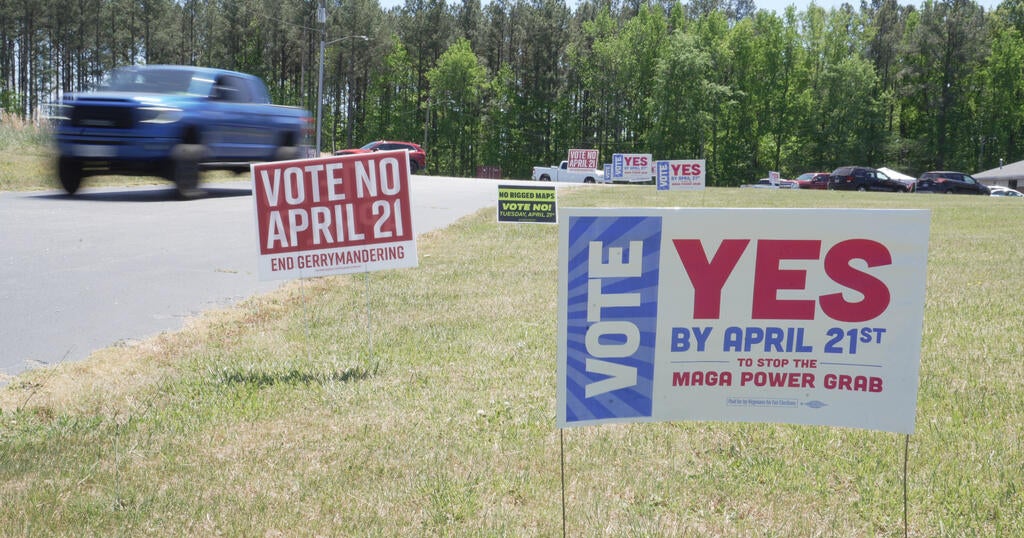
As it currently stands, the GOP plan appears to have backfired, leaving Democrats in the same, if not slightly better, position than before the national redistricting fight began. All eyes are now on Florida, where the pressure will be on Governor Ron DeSantis to deliver a new map that could gain Republicans between 3 and 5 seats. The odds are stacked against DeSantis, as the Special Legislative Session starts on Tuesday and he has yet to propose a new map. Any changes this late in the game are also likely to draw a flurry of legal challenges. Even with favorable maps, GOP congressional candidates could be in for a rough November. A new report by the Cook Political Report found Democrats leading Republicans by six points on a generic congressional ballot.

Of course, elections are not generic. Candidates matter, but money matters, too. A major ad buy from the Congressional Leadership Fund, the GOP Super PAC controlled by House Speaker Mike Johnson, has provided some insight into the Republican roadmap for maintaining control of the lower chamber. The $153 million ad buy will span across 38 media markets, including $13.9 million in South Texas, $20.4 million in Michigan, $18.6 million in New York City, and $12.6 million in Central California.
While a lot of the airtime reserved by Republicans is dedicated to defense, the $272 million ad-buy from the Democratic House Majority PAC is largely focused on offense. Mike Smith, the President of House Majority PAC, said in a statement, “With Trump’s numbers down wildly across the board, particularly on the economy and cost of living, it has given us an opportunity to go deeper and communicate with voters that traditionally voted Republican or haven’t voted at all, who are willing to take a chance on Democrats.” Even with the redistricting uncertainty, the group made a $20 million ad buy in Florida media markets, with $9 million in the Miami market to target GOP Reps. Maria Elvira Salazar and Carlos Gimenez, $6.6 million in the Tampa area for races against GOP Reps. Anna Paulina Luna and Laurel Lee, and $3.9 million in the Orlando area to focus on embattled Republican Rep. Cory Mills. Other nontraditional spends include $13 million in South Texas for three competitive races and $11 million across Iowa, focused on Republican Reps. Zach Nunn near Des Moines and Mariannette Miller-Meeks in eastern Iowa. Stay tuned.
“With Trump’s numbers down wildly across the board, in particularly on the economy and cost of living, it has given us an opportunity to go deeper and communicate with voters that traditionally voted Republican or haven’t voted at all, that are willing to take a chance on Democrats.”
Finally, just when Mets fans thought it couldn’t get worse, the blows keep coming. It started with a seemingly harmless hug between Mr. Met and NYC Mayor Mamdani, spiraling into what fans are now calling the “Curse of the Mambino.” As if that wasn’t enough, even The New York Times piled on with a correction that only added to the pain! |  |

Congratulations to our Marc Cohen, 2026 Who’s Who in Energy!


 | 🎙️Small signs of progress 🎙️Push for Upstate pied-à-terre tax 🎙️Why World Cup sticker shock in New Jersey has raised Jack’s ire! |
“Meet the Team” is our new podcast series highlighting the people who drive our firm’s success. This week we go ‘From the Lobby’ with Lauren Voorhees, a University of Toronto grad stepping into a full-time role in NYC.
Lauren is bringing a mix of legal insight, global experience, and next-gen thinking to her expanded Associate position. We get into: 🎙️How politics & psychology intersect |  |
 |  |


WATCH: BronxNet’s Sahtrese McQueen reports on the Fund for The City of New York’s “True Cost of Living Report" for New York City, which cites that over 46% of New Yorkers struggle to meet basic necessities.

Should New York’s budget process be reformed to give the Governor and the Legislature more equal authority? |


 |  |
 |  |


April 27, 1981: The future quietly clicked into place… literally! The world’s first commercial computer mouse made its debut, hitching a ride on a sleek, wildly expensive personal computer that promised tomorrow… but became a spectacular flop. |  |


 | One of America’s Top Glamping Campgrounds is in Upstate NYA new ranking reveals the top destination for glamorous camping is right here in our own backyard. Take a look! |
Was our Monday Morning Memo forwarded to you? Subscribe here to get it sent right to your inbox.